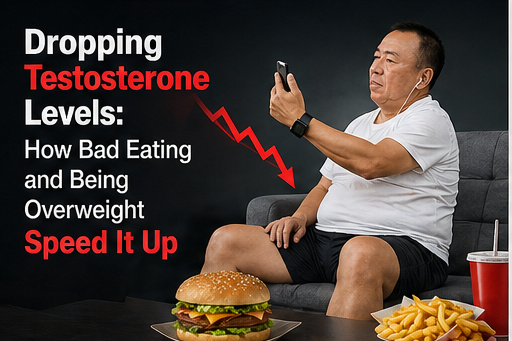
Why do some guys feel less energetic or strong as they get older? This is often about testosterone – that’s the main male hormone (like a chemical messenger in your body) that helps men build muscle, stay in a good mood, and have energy. It’s dropping faster these days because of junk food and extra weight. Think of testosterone as your body’s natural “power juice” getting low. If you lose your natural power, you get tired and lethargic. A viscous cycle.
What Are Natural Steroids Like Testosterone, and Why Do They Drop?
Testosterone is a type of natural steroid your body makes from cholesterol. It keeps men healthy by helping with muscles, bones, mood, and even making sperm. It is also a powerful anti-inflammatory hormone. But levels start falling around age 30, and bad habits make it worse.
- How it works in your body: Your brain’s hypothalamus sends a signal (GnRH) to the pituitary gland, which tells your testes (balls) to make testosterone using enzymes (tiny body workers) like CYP11A1. This is called the hypothalamic-pituitary-gonadal or HPG axis – like a chain of commands the sends signals to different parts of your body.
- Normal drop with age: After 30, it decreases 1-2% each year because the testes don’t respond as well. Imagine your energy slowly fading like a phone battery.
- When it’s too low (hypogonadism): If testosterone dips under 300 ng/dL, you might feel tired, gain belly fat, or have trouble with moods. Up to half of overweight guys have this!
- Symptoms explained simply: Low T can cause weak muscles (sarcopenia or muscle loss), trouble getting excited (erectile dysfunction), or feeling down – like your body’s engine running on low fuel.
Testosterone Now vs. 30 Years Ago: What’s Changed?
Back in the 1990s (30 years ago), guys had higher average testosterone because lifestyles were different. Now, levels are dropping faster across all ages, even in young dudes like 14-year-olds’ dads or uncles.
- Higher levels then: Studies of men from 1987-2004 show average T was about 500-600 ng/dL in 40-50 year olds. Today, it’s often 400-500 ng/dL or less – a 20-30% drop in some groups.
- Why lower now – obesity boom: Obesity rates doubled since the 90s (now over 40% of men). More fat means more aromatase converting T to estrogen, speeding the drop.
- Diet shifts: 30 years ago, less ultra-processed food (like fast food with hidden sugars). Now, high DII (Dietary Inflammatory Index – measures bad-food inflammation) diets are common, raising cytokines that block T production.
- Less activity: More desk jobs and screens mean sedentary life, lowering T by not stimulating muscle signals. Back then, more physical work kept the HPG axis running efficiently.
- Environmental stuff: More exposure to plastics with endocrine disruptors (chemicals messing with hormones) now, subtly lowering T across generations.Yes, plastics does influence your natural levels.
- Younger impact: Even teens and 20-somethings have 15-20% lower T than same-age guys 30 years ago, linked to rising kid obesity and poor sleep from phones.
- Overall trend: Longitudinal studies (tracking same people over time) show steeper drops now (1.6-3% yearly vs. 1% before), like aging hormones faster due to modern habits.
Why Diet Messes with Your Testosterone
Eating junk like sugary snacks or fried stuff hurts hormone-making. It’s technical because it involves inflammation (body swelling inside) and missing nutrients, but think of it as feeding your body bad gas for a car.
- Low-fat diets hurt: Fat is needed to make cholesterol for testosterone. Studies show low-fat eating drops free testosterone (the usable kind) by 10-15%. Like trying to build a Lego set without enough bricks.
- Sugar and insulin problems: Too much sugar raises insulin (a hormone for blood sugar), which turns testosterone into estrogen (a girl hormone) using an enzyme called aromatase. This throws off balance, like too much pink in a blue paint mix.
- Inflammation from bad food: Foods high in trans fats (in chips, donuts) cause cytokines (immune signals like IL-6) to rise, stressing your testes and making reactive oxygen species (ROS – like tiny rust-makers) that damage cells.
- Missing key nutrients: No zinc (in nuts), magnesium (in greens), or vitamin D (from sun or fish) means enzymes like 5α-reductase can’t work right. It’s like a recipe missing salt – the whole thing flops.
- Good diets help: Eating Mediterranean-style (veggies, fish, olive oil) lowers inflammation via omega-3s (healthy fats) and keeps insulin steady, boosting T levels.
How Obesity Makes Testosterone Drop – A Vicious Loop
Being overweight, especially with belly fat, is like a trap that lowers T and makes you gain more weight. Obesity means BMI over 30 (body mass index – weight vs. height score).
- Fat turns T into estrogen: Belly fat has lots of aromatase enzyme, changing testosterone to estradiol (estrogen). This tells your brain to make less T, like a feedback loop gone wrong.
- Leptin and brain signals: Fat cells make too much leptin (a hunger hormone), causing resistance so your brain’s kisspeptin (a starter signal for GnRH) doesn’t work. Imagine a remote control with dead batteries.
- Insulin resistance link: Extra weight makes cells ignore insulin, raising blood sugar and hurting testes’ energy use for making T enzymes like 3β-HSD.
- Oxidative stress: Obesity ramps up NADPH oxidase (a cell part making ROS), damaging Leydig cells (T-makers in testes) and blocking cholesterol transport with StAR protein.
- Numbers show it: Each BMI point up means 2% less T; losing 5-10% weight can raise it 10-20%. It’s a cycle – low T makes you fatter, fat makes T lower.
How to Fix It: Simple Steps to Boost Back Up
You can fight back with changes – no need for fancy stuff, just better habits.
- Lose weight smartly: Drop 5-10% body weight to cut aromatase and raise T 10-20%. Eat fewer calories but nutrient-rich foods. This is where peptides like GLP-1’s can really help.
- Exercise right: Lift weights to activate mTOR (a growth path) for T spikes; avoid too much long cardio that can lower it.
- Eat better: Add zinc rich foods (oysters), vitamin D (sunny walks), and healthy fats to support enzymes. Avoid SEED OILS, these are very inflammatory.
- Sleep and stress: Get 7-9 hours sleep; chill with friends to lower cortisol (stress hormone) that fights T.
References
- Eriksson J, Haring R, Grarup N, et al. Causal relationship between obesity and serum testosterone status in men: A bi-directional mendelian randomization analysis. PLoS One. 2017;12(4):e0176277. doi:10.1371/journal.pone.0176277. Available at: https://pubmed.ncbi.nlm.nih.gov/28448539
- Skoracka K, Eder P, Łykowska-Szuber L, Dobrowolska A, Krela-Kaźmierczak I. Diet and Nutritional Factors in Male (In)fertility-Underestimated Factors. J Clin Med. 2020;9(5):1400. doi:10.3390/jcm9051400. Available at: https://pubmed.ncbi.nlm.nih.gov/32397485