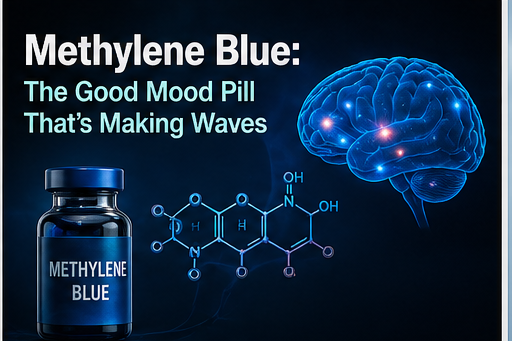
Imagine a bright blue dye invented over 100 years ago that’s now buzzing on social media as a brain booster and mood lifter. That’s methylene blue—a compound once used to treat malaria and now hailed by some as the “good mood pill.” But is it really a miracle for your mind, or just hype? In this quick read, we’ll dive into its benefits, risks, FDA rules, why you should only get it from a trusted pharmacy, and what the future holds. Let’s unpack the science behind this intriguing blue wonder.
What Is Methylene Blue?
Methylene blue is a synthetic dye discovered in the 1800s. It’s been a medical tool for decades, mainly to fix a rare blood issue where oxygen doesn’t flow right in your body. Lately, people are taking low doses for off-label reasons—like perking up their mood or sharpening their focus. It works by supercharging your cells’ energy factories (mitochondria), fighting inflammation, and tweaking brain chemicals like serotonin. But remember, it’s not a candy—it’s serious stuff that needs careful handling.
The Exciting Benefits
Fans call methylene blue a game-changer for mental health and wellness. Research shows it might help with mood by acting like a mild antidepressant. For example, small studies suggest it can ease depression symptoms and stabilize moods in people with bipolar disorder, without the risk of sparking mania. It boosts brain energy, which could improve memory, focus, and even fight brain fog from conditions like long COVID or fibromyalgia.
Other perks include:
- Neuroprotection: It shields brain cells from damage, showing promise against Alzheimer’s and dementia by reducing oxidative stress (that harmful cell rust).
- Anti-aging vibes: Some early lab work hints it slows cell aging and supports heart health.
- Antimicrobial power: It fights infections, like in malaria or urinary tract issues.
- Energy and clarity: By revving up mitochondria, it might help with fatigue and mental sharpness.
These benefits come from studies, but they’re mostly preliminary—not rock-solid proof yet. Still, for folks seeking natural-ish mood support, it’s fascinating.
The Risks You Can’t Ignore
No pill is perfect, and methylene blue has downsides. Common side effects include turning your pee or poop blue-green (harmless but weird), headaches, dizziness, or nausea at higher doses. More seriously, it can cause serotonin syndrome—a dangerous buildup of brain chemicals—if mixed with antidepressants like Prozac or Cymbalta. Symptoms? Agitation, fever, fast heart rate, even seizures or death. The FDA warns about this big time.
It’s off-limits if you’re pregnant (it can harm babies), have G6PD deficiency (a genetic blood issue), or kidney problems. High doses might drop blood pressure or cause confusion. Always chat with a doctor first—self-dosing is risky.
FDA Status and Regulations
The FDA approves methylene blue only for methemoglobinemia, that blood oxygen problem. All the mood and brain stuff? That’s off-label, meaning doctors can prescribe it, but it’s not officially backed for those uses. Supplements aren’t regulated like drugs, so quality varies wildly—no FDA checks for purity or strength.
Rules are strict on interactions: Since it’s like an MAO inhibitor (a type of antidepressant), combining it with certain meds is a no-go. Insurance might cover it for approved uses, but off-label? You’re paying out-of-pocket.
Why Stick to a 503A Pharmacy?
Here’s the scary part: If you buy methylene blue online or as a supplement, you might get junk. Industrial-grade versions are used as dyes in labs, aquariums, or even pool cleaners to fight algae—not for humans! They could have impurities, heavy metals, or wrong doses, leading to poisoning or zero benefits.
A 503A compounding pharmacy is your safe bet. These licensed spots make custom doses under strict FDA guidelines for individual patients with a prescription. They test for purity, sterility, and exact strength—no sketchy stuff. Think fresh, tailored capsules or IVs, not mystery blue powder. Skipping this? You’re gambling with your health.
The Bright Blue Future
Methylene blue’s story is far from over. Scientists are pumped about its potential in big trials for Alzheimer’s, Parkinson’s, and mood disorders. Imagine it as an add-on to depression treatments or a shield against brain aging. Research on long COVID and inflammation looks promising too. But we need more human studies to confirm safety and doses—right now, it’s exciting but not proven.
In the long run, if research pans out, it could revolutionize mental health care, offering a cheap, multi-tasking tool for wellness.
Wrapping It Up
Methylene blue, the “good mood pill,” blends old-school medicine with cutting-edge hope. Its mood-lifting, brain-protecting perks are intriguing, but risks like drug clashes demand caution. Stick to FDA rules, get it from a 503A pharmacy to avoid dodgy sources, and watch for future breakthroughs. If you’re curious, talk to a doc—your brain will thank you. Who knew a simple blue dye could spark such fascination?
- Methylene Blue Authors: Evangelos Bistas and Devang Sanghavi Published in: StatPearls [Internet]. Treasure Island (FL): StatPearls Publishing; 2025 Jan-. Last Update: June 26, 2023. Available at: https://www.ncbi.nlm.nih.gov/books/NBK557593/ (open access via NCBI Bookshelf, PMID: 32491525).
This comprehensive StatPearls review covers methylene blue’s established medical uses, mechanism of action (including its potent monoamine oxidase A inhibition, which links to antidepressant-like effects), administration routes, and key risks like serotonin syndrome when combined with serotonergic drugs (e.g., SSRIs or SNRIs). It highlights FDA approval for methemoglobinemia and off-label applications, while warning about interactions that can cause serious CNS toxicity. This source directly supports the article’s sections on FDA status, regulations, risks (especially serotonin syndrome), and why professional oversight is essential. It provides a balanced, evidence-based foundation for safe use discussions.
- Methylene blue treatment for residual symptoms of bipolar disorder: randomised crossover study Authors: Martin Alda, Margaret McKinnon, Ryan Grant, and Glenda MacQueen Published in: The British Journal of Psychiatry (2017), Volume 210, Issue 1, Pages 54-60. DOI: 10.1192/bjp.bp.115.173930 (available via PubMed or Cambridge Core).
This double-blind, randomized crossover trial tested low-dose (15 mg, “placebo”) vs. active-dose (195 mg) methylene blue as an add-on to lamotrigine in patients with bipolar disorder. The active dose significantly reduced residual depression symptoms (on Montgomery-Åsberg and Hamilton Depression Rating Scales, p=0.02 and 0.05) and anxiety (Hamilton Anxiety Scale, p=0.02), with stable mania symptoms and good tolerability (only mild, transient side effects). Mania didn’t increase, addressing a common concern with mood treatments. This study strongly backs the “good mood pill” claims, showing real antidepressant and anxiolytic benefits in a clinical setting—perfect for the benefits section—while reinforcing the need for medical supervision and proper sourcing to avoid risks.
What Are Natural Steroids Like Testosterone, and Why Do They Drop?
Testosterone is a type of natural steroid your body makes from cholesterol. It keeps men healthy by helping with muscles, bones, mood, and even making sperm. It is also a powerful anti-inflammatory hormone. But levels start falling around age 30, and bad habits make it worse.
- How it works in your body: Your brain’s hypothalamus sends a signal (GnRH) to the pituitary gland, which tells your testes (balls) to make testosterone using enzymes (tiny body workers) like CYP11A1. This is called the hypothalamic-pituitary-gonadal or HPG axis – like a chain of commands the sends signals to different parts of your body.
- Normal drop with age: After 30, it decreases 1-2% each year because the testes don’t respond as well. Imagine your energy slowly fading like a phone battery.
- When it’s too low (hypogonadism): If testosterone dips under 300 ng/dL, you might feel tired, gain belly fat, or have trouble with moods. Up to half of overweight guys have this!
- Symptoms explained simply: Low T can cause weak muscles (sarcopenia or muscle loss), trouble getting excited (erectile dysfunction), or feeling down – like your body’s engine running on low fuel.
Testosterone Now vs. 30 Years Ago: What’s Changed?
Back in the 1990s (30 years ago), guys had higher average testosterone because lifestyles were different. Now, levels are dropping faster across all ages, even in young dudes like 14-year-olds’ dads or uncles.
- Higher levels then: Studies of men from 1987-2004 show average T was about 500-600 ng/dL in 40-50 year olds. Today, it’s often 400-500 ng/dL or less – a 20-30% drop in some groups.
- Why lower now – obesity boom: Obesity rates doubled since the 90s (now over 40% of men). More fat means more aromatase converting T to estrogen, speeding the drop.
- Diet shifts: 30 years ago, less ultra-processed food (like fast food with hidden sugars). Now, high DII (Dietary Inflammatory Index – measures bad-food inflammation) diets are common, raising cytokines that block T production.
- Less activity: More desk jobs and screens mean sedentary life, lowering T by not stimulating muscle signals. Back then, more physical work kept the HPG axis running efficiently.
- Environmental stuff: More exposure to plastics with endocrine disruptors (chemicals messing with hormones) now, subtly lowering T across generations.Yes, plastics does influence your natural levels.
- Younger impact: Even teens and 20-somethings have 15-20% lower T than same-age guys 30 years ago, linked to rising kid obesity and poor sleep from phones.
- Overall trend: Longitudinal studies (tracking same people over time) show steeper drops now (1.6-3% yearly vs. 1% before), like aging hormones faster due to modern habits.
Why Diet Messes with Your Testosterone
Eating junk like sugary snacks or fried stuff hurts hormone-making. It’s technical because it involves inflammation (body swelling inside) and missing nutrients, but think of it as feeding your body bad gas for a car.
- Low-fat diets hurt: Fat is needed to make cholesterol for testosterone. Studies show low-fat eating drops free testosterone (the usable kind) by 10-15%. Like trying to build a Lego set without enough bricks.
- Sugar and insulin problems: Too much sugar raises insulin (a hormone for blood sugar), which turns testosterone into estrogen (a girl hormone) using an enzyme called aromatase. This throws off balance, like too much pink in a blue paint mix.
- Inflammation from bad food: Foods high in trans fats (in chips, donuts) cause cytokines (immune signals like IL-6) to rise, stressing your testes and making reactive oxygen species (ROS – like tiny rust-makers) that damage cells.
- Missing key nutrients: No zinc (in nuts), magnesium (in greens), or vitamin D (from sun or fish) means enzymes like 5α-reductase can’t work right. It’s like a recipe missing salt – the whole thing flops.
- Good diets help: Eating Mediterranean-style (veggies, fish, olive oil) lowers inflammation via omega-3s (healthy fats) and keeps insulin steady, boosting T levels.
How Obesity Makes Testosterone Drop – A Vicious Loop
Being overweight, especially with belly fat, is like a trap that lowers T and makes you gain more weight. Obesity means BMI over 30 (body mass index – weight vs. height score).
- Fat turns T into estrogen: Belly fat has lots of aromatase enzyme, changing testosterone to estradiol (estrogen). This tells your brain to make less T, like a feedback loop gone wrong.
- Leptin and brain signals: Fat cells make too much leptin (a hunger hormone), causing resistance so your brain’s kisspeptin (a starter signal for GnRH) doesn’t work. Imagine a remote control with dead batteries.
- Insulin resistance link: Extra weight makes cells ignore insulin, raising blood sugar and hurting testes’ energy use for making T enzymes like 3β-HSD.
- Oxidative stress: Obesity ramps up NADPH oxidase (a cell part making ROS), damaging Leydig cells (T-makers in testes) and blocking cholesterol transport with StAR protein.
- Numbers show it: Each BMI point up means 2% less T; losing 5-10% weight can raise it 10-20%. It’s a cycle – low T makes you fatter, fat makes T lower.
How to Fix It: Simple Steps to Boost Back Up
You can fight back with changes – no need for fancy stuff, just better habits.
- Lose weight smartly: Drop 5-10% body weight to cut aromatase and raise T 10-20%. Eat fewer calories but nutrient-rich foods. This is where peptides like GLP-1’s can really help.
- Exercise right: Lift weights to activate mTOR (a growth path) for T spikes; avoid too much long cardio that can lower it.
- Eat better: Add zinc rich foods (oysters), vitamin D (sunny walks), and healthy fats to support enzymes. Avoid SEED OILS, these are very inflammatory.
- Sleep and stress: Get 7-9 hours sleep; chill with friends to lower cortisol (stress hormone) that fights T.
References
- Eriksson J, Haring R, Grarup N, et al. Causal relationship between obesity and serum testosterone status in men: A bi-directional mendelian randomization analysis. PLoS One. 2017;12(4):e0176277. doi:10.1371/journal.pone.0176277. Available at: https://pubmed.ncbi.nlm.nih.gov/28448539
- Skoracka K, Eder P, Łykowska-Szuber L, Dobrowolska A, Krela-Kaźmierczak I. Diet and Nutritional Factors in Male (In)fertility-Underestimated Factors. J Clin Med. 2020;9(5):1400. doi:10.3390/jcm9051400. Available at: https://pubmed.ncbi.nlm.nih.gov/32397485